The Person Behind The Posts

Wednesday, April 27, 2011

Seeing With Affectionate Eyes

Over Pesach, I read a couple of novels for pleasure.  One of them was Islands by Anne Rivers Siddons, The novel is about a group of lifelong friends and how they cope with aging and loss.  But more to the point, the book is set in Charleston, SC.

I'm pretty sure I've been in Charleston, SC at least once in my life, but it left nary an impression on me. For Anne Rivers Siddons, however, Charleston and the South Carolina Lowcountry is as vivid as a character in the novel.

Generally, I skim quickly over descriptions of scenery in books, jumping to dialog or drama for much the same reason that I prefer lyrics to music alone.  I am exceedingly verbally wired.  I didn't read many of the scenic passages in this book either, but it did occur to me that the author must love that part of the world quite a lot to write about it in such detail.  She sees the South Carolina Lowcountry with affectionate eyes and, as a result, she notices its details - its smells, its sounds, its color.

And that inspired me to notice more of the details in the place I love.  Even though I don't yet feel wholly at home here in Israel, there are so many things I love and, inspired by the novel, I tried to remember to notice them.
In grocery stores all over Israel, the aisles of chametz, foods that we don't eat on Pesach, are covered up.  I know this isn't the prettiest photo, but look below for a detailed image of the graphic.
It says, "Chag Aviv Sameach" in Hebrew.  Even the plastic sheeting in the grocery stores in Israel wishes the Jewish People a happy Passover - a happy springtime holiday.

Today, we drove to the Dead Sea on Route 90. We had the Dead Sea to our left and this amazing vista to our right.  If you look closely at about 9:00, you'll see what I think is an opening to one of the many caves in the the area, not far from Kumran where the Dead Sea Scrolls were found.  This scenery is 30 minutes from our home and  I can go see it whenever I want.
This was a tiny little hop-plop snack bar on the side of the road in the middle of nowhere, selling cold drinks and not much else.  I loved it so much, I wanted to buy something there, just so it would remain in business.
As we sat at the shaded tables eating lunch, I glanced over and saw this tree.  I have no idea  what kind it is, but I love it nonetheless because it grows in Israel.
I saw many other things through affectionate eyes today - like floating on my back in the Dead Sea and looking up at this view:

And the Dead Sea mud hole that was, literally, an unadorned hole in the ground. I didn't get in because I wasn't sure I would have been able to get out, but I did see lots of these mud people.  My mud people.


I've loved these last few days of seeing Israel with affectionate eyes.

May I always be privileged to remember to look.

Thursday, April 21, 2011

Ascending Har HaBayit

A few weeks ago, an old friend sent us an email inviting us to tour Har HaBayit (The Temple Mount) with her family on the first day of Chol HaMoed (the middle days of the Pesach holiday).  Immediately, I felt conflicted.  I knew that ascending Har HaBayit is considered controversial, especially for women.  Har HaBayit is the mountaintop where the First and Second Temples stood and where the Third Holy Temple will be rebuilt very soon, Gd-willing.  The holiness of the site is so extreme, so much more so than the Kotel (Western Wall), that many say we are not spiritually prepared to ascend in these days.

Holiness, or the prospect of being close to such holiness, invokes a feeling of awe.  I wanted to go and was afraid to go in equal measure.  So I asked my rabbi for a ruling according to Jewish law.

He was very encouraging and told us exactly how to prepare.  Ascending the Temple Mount requires immersion in a mikvah and one must wear non-leather shoes.  My friend had arranged for a knowledgeable tour guide to lead us, both to explain what we were seeing and also to keep us on the permitted path, since Jews in today's time may not walk too close to the exact place where the Temples stood.

In the end, we decided to go.  We met near the entrance to the Mughrabi Gate, right off the Kotel Plaza. We were a group of about 15 religious Jews.

At the Mughrabi Gate, throngs of non-Jewish tourists were ushered through as quickly as if they were entering a shopping mall.  A brief pass through a metal detector and off they went.  We, obviously religious Jews, were required to present ID and to wait over half an hour for clearance.  Once we were cleared to enter, we were followed the entire time by a handful of Israeli police officers who kept urging us to move along.

I realize that they are charged with keeping peace, and that, as religious Jews, we might "make trouble", but the fact that non-Jews are assumed to be mere tourists, permitted to walk all over the Temple Mount without escorts while religious Jews are suspected of coming for incendiary purposes is, minimally, hurtful.

Being singled out for an intensive security check, being made to wait while hordes of non-Jews were passed through in moments and being watched and urged along by 3 or 4 eagle-eyed Israeli police were the first of several surprises of the morning.

What were my impressions, as a first-timer?   The mountain top is huge, with many open plaza areas.


There are dozens of Muslim buildings, large and small, up there.


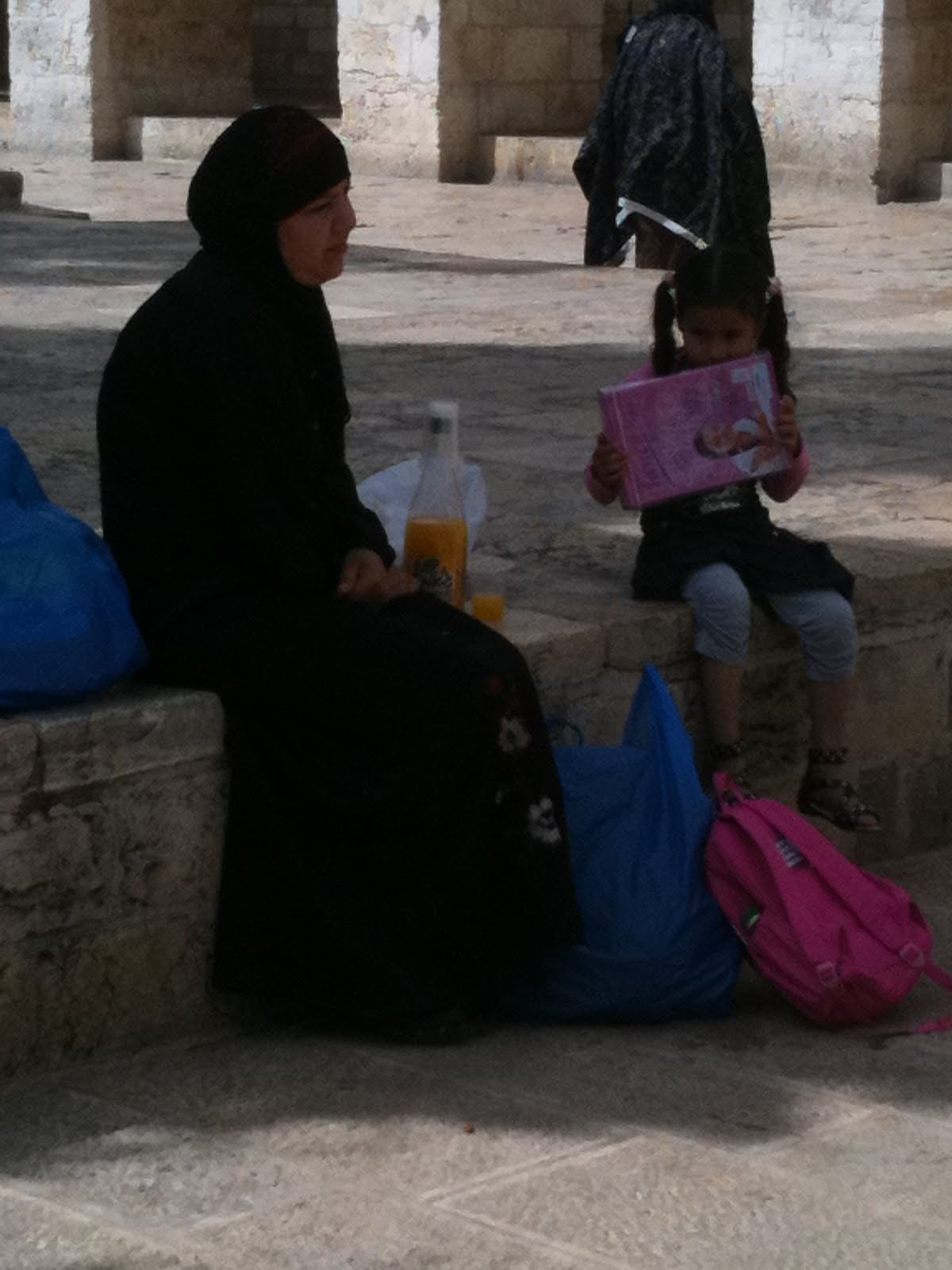
The whole place was filled with Arabs, for whom the Temple Mount, among other things, seems to serve as something of a National Park, with lots of lovely places to have a picnic.

Notice the Arab women enjoying their picnic behind the trees.


Didn't get a photo, but about halfway into our tour, we passed what seemed to be a school with dozens of Arab boys outside at recess, playing soccer, making a lot of noise.  We were walking, quietly and respectfully around the perimeter, being followed like hawks, lest we move our lips in prayer at the holiest Jewish site in the universe, while Arabs were everywhere, eating lunch and playing soccer and non-Jewish tourists were roaming around without a hint of reverence.

One of many non-Jewish groups with whom we shared HarHaBayit.
Deeply, deeply ironic.

That contrast sparked strong feelings among the people in our group.  Why don't more religious Jews come up here?  Why have we ceded the holiest ground in the universe to Arabs, Christians and secular tourists?

While walking around, careful not to move my lips, I spoke to Gd in my head and heart.  I'm sure the others in our group did as well.

Finally, we were near the most dramatic place of all, The Dome of the Rock, built by Muslims in the 7th Century, on the very place where the Temple stood.  It makes me shake with awe to think of how close we were.


We couldn't get any closer.  There is so much more holiness here than anywhere else in the world.  Perhaps that's why this veiled Arab woman chose this exact spot to sit and beg for charity.


At this spot, the tour guide reminded us that, as Jews who ascended Har HaBayit, we were praying with our feet.  He encouraged us to come back and to bring others with us.

As we exited, though an ordinary door into the Arab shuk, the men in our tour group spontaneously burst into song and dance, a prayer for the rebuilding of the Holy Temple.


And that's when I started to cry.

Sunday, April 17, 2011

Erev Pesach Photo Blog

An early sign of Pesach (or any Jewish holiday in Israel, actually) is that the Coke bottles and potato chip bags start offering holiday wishes to the Jewish people.  Look to the left of the colorful Coke bottle.  It says, "Chag Sameach" (Happy Holiday) in Hebrew.
Stacks and stacks of Kosher for Passover Coke, all bearing the Chag Sameach greeting.
The onions in Israel are often sold with, ahem, a different level of attention to dirt removal.  It takes some getting used to, but I find it earthy and more real than overly sanitized produce in Styrofoam, covered in plastic.  What does this have to do with Pesach?  Well, I cook with a lot of onion on Pesach :-)  

  
Walking around the Shuk the day before the Seder, we found lots of men working hard to help Jews sell their chametz before the holiday begins. 

Other opportunities to sell one's chametz included this "Lucy booth" at the Malcha Mall, 
right in front of a grocery store.
In Baltimore, burning the last of our chametz was a major community event a few miles from home.  Here, it was a much more modest affair.  We walked across the street, put our bag of stale bread, crackers and cereal on the pile, said the appropriate prayer in Hebrew and English and walked back across the street for lunch, all in under 10 minutes.
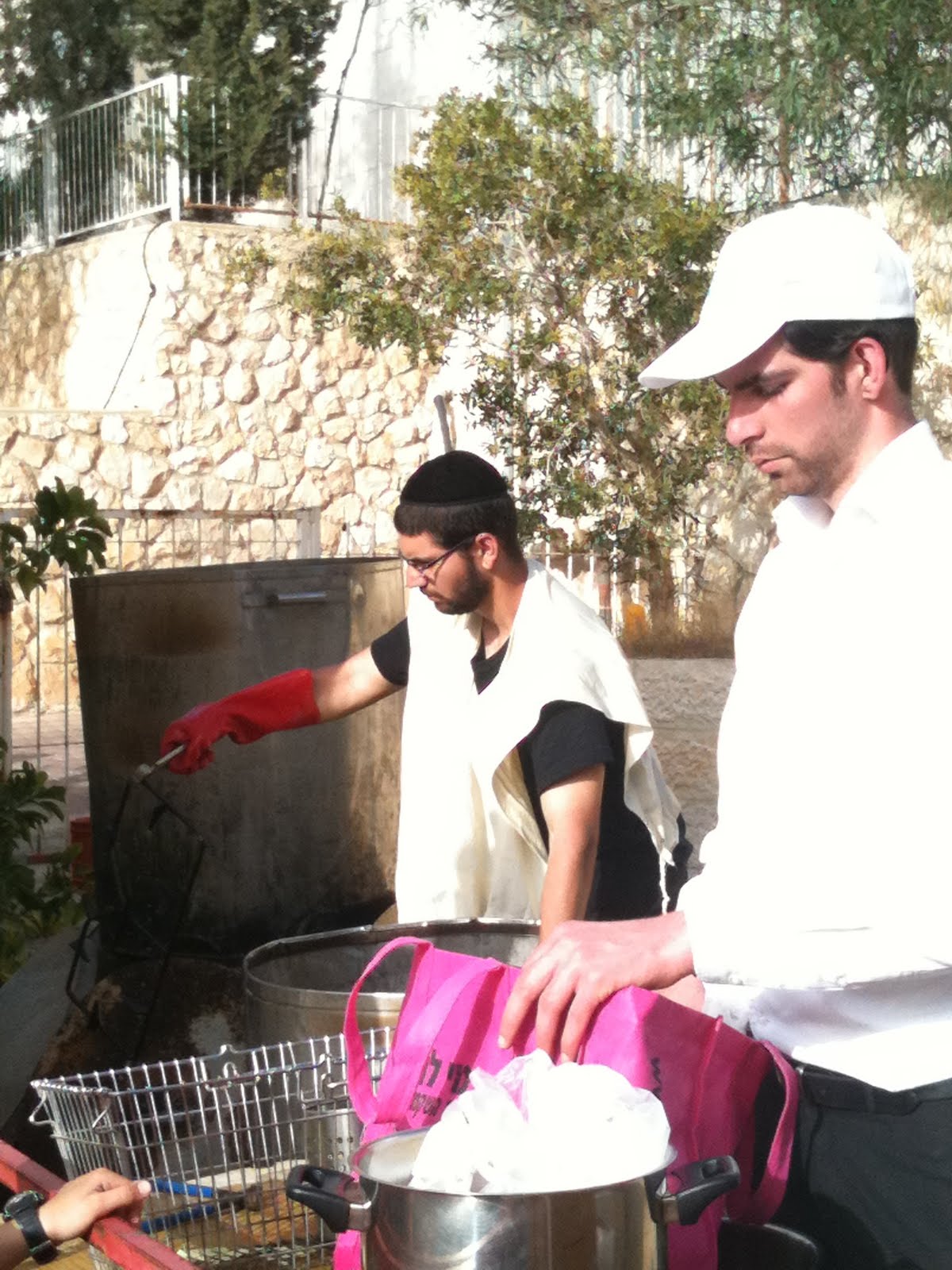
Notice the giant pot next to the yeshiva guy with the red glove and the tongs.  The pot is almost as tall as a person, filled with boiling water.  All day long, neighbors line up at the ha'agala station where people can bring their utensils, pots,oven racks and other metal objects to immerse in boiling water to make them kosher for Passover use.  This is a free service provided all over Israel.  Just one more way Jewish life is easier to live in this country. 


Finally, my official Israeli driver's license arrived in the mail this week.  Now I'm 2/3 of the way to the Israeli Citizenship Trifecta.  All I need is an Israeli passport, for which I become eligible after we've been living here a full year.  No road test to get a passport.  Just one more reason to rejoice on Pesach.
!חג כשר ושמח לכל היהודים בכל מקום
A happy and kosher Passover to all Jews everywhere!

Tuesday, April 12, 2011

Israel Standard Time

Decades ago, my first job out of graduate school was at an Historically Black University. Among certain members of the staff, there was a concerted effort to teach me - the new, young, white, Jewish colleague, about their culture.  One of the expressions I learned that year was [WARNING: racially sensitive comment follows] "CP Time" which Urban Dictionary defines as, "The usually correct stereotype that African-Americans are incapable of punctuality, and are chronically tardy in both arriving at and beginning events and functions."


I think of that expression now and then because it reminds me of the similar expression "Jewish Standard Time" which seems to operate in very much the same way.


Then there's something about time in Israel whose name I do not know but under whose influence I live on a daily basis.


I experience time in Israel differently than I did before.  In some senses, time passes much more quickly here. We just had our nine month aliyahversary and I can't believe we've already been here that long.  Perhaps a better example is a conversation I had with a neighbor who was trying to explain to me why she hadn't gotten around to calling me about a shul issue.  She said, "Shabbat ends and I intend to do something about it, but then I blink and it's Friday again."


My life revolved around Shabbat in America too, but it's different here.


Of course, the classic example of Israel Standard Time is "acharei hachagim" (literally, after the holidays) which is an absolutely legitimate excuse for postponing anything due in the general proximity of a major Jewish holiday.


But there's another sense of Israel Standard Time that comes from being more in tune with the Divine.  We might fairly call it God Standard Time.  It's the sense, palpable here in Israel, that things move, not according to our schedule, but according to some Divine Plan.  After living here awhile, one becomes adept at foregoing any solid expectations about when things will happen.  It's humbling, in a way, to be constantly reminded that the world runs on a timetable entirely separate from the one in my calendar. 


I had a hint about this before I came to live in Israel full-time.  On a few trips here, I needed to conduct a handful of business meetings.  Being the conscientious American administrator that I was, I tried to set appointments weeks in advance. Invariably, my Israeli counterparts would say, "Call me when you're here and we'll arrange something."  I thought it was an odd way of doing business, but now I see that it's more accurate to say that it's an Israeli way of doing life.


I detect something admirable, if unarticulated, in the constant awareness that things can change in a heartbeat because God runs the world.  It's not that Israelis don't ever plan for the future, but there is a profound respect here for the malleability of the future.  It takes some time for inveterate Western thinking to change.


A corollary to this is the way that I have adapted to things not happening when they were originally supposed to.  Lots of stuff plainly takes an uncommonly long time to accomplish here.  There's a great Israeli expression  one hears in response to a demand for an explanation for which there simply is no explanation - kacha zeh - that's just the way it is.  I've watched myself going through The Three Stages Of Kacha Zeh:


Stage 1 - That is just an unacceptable answer!
Stage 2 - Oh well!
Stage 3 - I can't believe I just answered kacha zeh in response to someone else's question!


One learns to live inside the flow of time and not rush things.  Things (jobs, events, friendships, construction, resolution of bureaucratic glitches, etc.) bloom in their right season. 


 It's very Zen, very Simple Living. And, in the end, very biblical.*


* See Kohelet (Ecclesiastes) 3:1.  Or The Byrds.

Tuesday, March 29, 2011

Driving Me Crazy

I knew, when we came on aliyah, that eventually, I would have to face the one bureaucratic demon I was most afraid to face - converting my driver's license.

I knew that it was a complicated process, involving about 17 disjointed steps.  Pay a fee and get this piece of paper here.  Get it signed here.  Pay this fee there.  Get it stamped here, here and here.  I completed the first several steps during our first weeks here and then I started ulpan, which provided a legitimate excuse to put the whole project on the shelf.

In reality, I was avoiding the next stage, which involved taking one or more driving lessons and then taking a road test.

There's a rumor among olim that it used to be possible to simply transfer your license from outside of Israel the way you would if you moved from one state in the US to another.  Then there was an influx of immigrants with forged licenses who didn't really know how to drive and the policy was changed, requiring all drivers, no matter what country their original license was issued in, to take a minimum of one lesson and pass a road test.  I don't even know if the rumor is accurate.  But I did know that I would be required to take a driving test to get my license in Israel.

The thought was so anxiety-producing that I avoided it for a few more months.

Finally, I scheduled my lesson.  The first time I showed up, I didn't have the right paperwork.  The second time, I was able to complete my lesson, but the experience of driving with someone who was watching and judging my every move behind the wheel was totally nerve wracking.  Nevertheless, at the end of the lesson, the driving instructor offered me a test date, so I knew I must have done well enough not to require a second lesson.

A week later, on the test date, I was one of three experienced drivers trying to get our American licenses converted.  I was the second driver out on the course.  My heart was pounding, thumping in my chest as I got behind the wheel.  I have been driving for well over three decades, but I felt like a teenager.

Another quirk of the Israeli system is that they don't tell you right away whether you passed or not. Again, the rumor is that once, a driver was told on the spot that he failed the test and he either shot or knifed the tester.

So now you have to wait until the late afternoon and call your driving instructor for the results.

I forgot to mention that, in addition to everything else, I'd already laid out close to 800 shekels (more than $200).

Can it be any more torturous a process?

Yes, it apparently can.  Because after some 35 years of driving without so much as a speeding ticket or an insurance claim in decades, I failed my road test.

I failed my road test.

I failed my road test and I plunged into the depths of despair.  I began thinking - I am in Israel almost nine months and the job I might have hasn't exactly come together, I can't really speak the language, despite my best efforts in an intensive ulpan and now, I have lost the ability to drive approximately three decades earlier than most adults do.  I was hurt and angry and feeling very, very low.  I kept noticing flagrant violations made by other drivers.  I saw plenty of terrible drivers in Israel.  How could it be that I was being denied a license?

Yes, I knew that I had one more chance.  I also knew that if I didn't pass a second road test, I would need to take 20 or more lessons, at 150 shekels each, just like a brand new driver.

I was angry, I was hurt and I was highly uncharacteristically down on myself.

Initially, I wanted to avoid everything connected with cars and driving.  I thought a lot about how this was going to impact my family, not being able to drive to the grocery store or to take someone to a doctor's appointment.  I couldn't think of more than a handful of adults who didn't drive, unless they lived in Israel and had never had a car.  I alternated between feeling deeply resentful of a system that was prepared to strip me of my ability to drive with trying very hard to accept this new reality as the will of my Creator.  Hashem willed that I not be able to drive anymore and I had to get to the place where I could accept that.

I had to find some spiritual comfort.  I told myself that the principles of emunah required me to see this as a good thing.  Everything Hashem does it for the good.  So my job was to figure out how this could be good.

Maybe it's my destiny to die or worse, to kill someone (Gd forbid!), while I'm behind the wheel.  So Hashem took away the chance to fulfill that destiny by taking away the chance for me to ever drive again.

The gemara says that three things are earned through yisurim (suffering) - Torah, Israel and the World to Come.  Maybe giving up the ability to drive is part of the price I have to pay to live in Israel.

I thought about it a lot.

Then, last night, while we were sitting in parent-teacher meetings, the driving instructor called and said he had a last-minute cancellation for this morning.  I accepted the appointment and told myself the outcome was in Hashem's Hands.

As an extra precaution, I drove home from Jerusalem last night and back into the city this morning, figuring that any recent time behind the wheel might eliminate a small fraction of my anxiety.

By the time I sat behind the wheel of the test vehicle (in Israel, you use your instructor's car for the road test), I felt that I was truly in a place of acceptance.  Whatever happened, whatever the outcome of this second chance, it was all in Gd's Hands, not mine.


Baruch Hashem, I passed.

Friday, March 25, 2011

Responding To A Cry From The Heart

In my email this morning, I found this cry for spiritual clarity from a wife and mother still living in America:


...sorry to sound like the simple son, what are we supposed to do? Are we to distrust rabbis who do not publically speak out to their flocks that it is time to make aliyah? Are these articles saying that we should hurriedly leave America before a possible US attack on Israel at which time, G-d forbid it could be too late to be able to leave? It's obvious that everything is speeding up in all ways around the globe. I need it spelled out with no hints. What are you or others in the know saying to do, now? Increase mitzvos, tefilla, etc. Are you also saying leave NOW? 


Here is my response:

You have always impressed me as a sensitive,spiritual woman and your message confirms this impression.  Kol HaKavod for asking such an important question.  The irony is that, if it was as clear as you would like me to make it, you wouldn't have to ask.

I am no navi and I have no inside information that is hidden to others.  All I can say is that the calls from rabbinic voices in Israel to make aliyah NOW are stronger and more frequent than ever.  We have, as a people, consistently stayed too long in every exile, assuming the trouble will pass if we just lay low.  But, as you can see with your own eyes, Jewish history is dramatically speeding up.

It seems to me there are three choices here:

1) Sit tight and wait for Moshiach.

2) Come as soon as possible.

3) At least make serious preparations - sell off what you can, get your money out of dollars and into shekelim in an account here, get the paperwork done so you're approved for aliyah, have a concrete Plan B so you can leave right away when you sense yourself that it's time to go.

There are those who will counter that, with the recent uptick in terrorist attacks of various kinds in Israel, it's crazy to come now.  I personally believe that there is no place safer for Jews at this time in history than Eretz Yisrael.  Although people have died here al Kiddush Hashem in recent weeks, it's impossible to me that, this close to the next stage of Jewish history, Am Yisrael as a whole will be safer in someone else's country than we are at Home.

My rabbis are teaching that the Shechina has already departed from everywhere outside of Israel, and the surest sign of this is an increase in open antisemitism.  I think of Helen Thomas, an American icon, and her recent words against the Jewish people, not whispered quietly in someone's living room, but published and broadcast all over the world.  Others will have other examples of open antisemitism.  

If the Shechina no longer rests with the Jewish people outside of Israel, those remaining there are living without spiritual protection and are, therefore, incredibly vulnerable to a rapid shift in fortunes.  Why would anyone want to stay in that circumstance?

It's really a matter of choosing for which team you want to play at this time in history. Where's your loyalty?  With whom do you identify more?  Which circumstance do you trust more to keep you and your loved ones safe during dramatic times - America without the Shechina or Hashem with Am Yisrael in Eretz Yisrael?

At this stage, we still have a choice - to see the direction history is taking us, to feel in our guts that the Redemption is coming and to get on board, or to live as if all this chaos is not game-changing in any way, but just another series of worldwide crises that will pass, allowing us to return to our normal lives soon enough.

It seems to me that Hashem is asking each of us to choose.  

And it seems to me that the correct answer is very clear.

Wednesday, March 23, 2011

Another Israeli First

This was my first experience of a bombing in Jerusalem as an actual Israeli, living very close to Jerusalem.  When the bomb first went off, my older daughter, doing her National Service in Jerusalem, called to tell me there had been an explosion.  At that point, the details were scant, and some would later prove to be inaccurate.

I went right to the computer.  As soon as I saw the first report online, I started to cry. 

The bus stop where the bomb went off is exactly where we stand to get a bus home.

I should have known that my younger daughter would hear about it soon enough, though I had hoped to shield her from it. Just this morning, she called me from school to ask how far Itamar is from our home.  She is still dealing with feeling vulnerable after the massacres in Itamar, and this one hit a lot closer to home.


It's a little strange to be on the receiving end of calls and emails checking to see if we're okay - from family, from a friend who has three adult children living here, a nephew who was recently here visiting, and from pretty much the last person I might ever have expected to hear from - a former colleague with whom I last worked over 20 years ago.  It's also a little unsettling and strange not to have heard from others with whom we are much closer.

I spent hours online, hungry for every last detail, watching as the story unfolded.  I sat with seven or eight tabs open in my Internet browser, constantly refreshing them.  I stepped away twice to say Tehillim, the same five chapters that we were instructed to say during the Second Intifada.  But mostly, I was desperate for details, constantly checking news sites, updating my Facebook status.  I couldn't pull myself away.

Having spent so much time online, it was inevitable that I ended up reading more about the escalation of rockets in southern Israel - Ashdod, Ashkelon and Beer Sheva coming from Gaza.  And the analyses that suggest that war is coming once again to Israel.

Because I spend a lot of time in the world of bloggers who write about the impending geula and rabbis who teach about world events in the context of moving Jewish history forward, I have a spiritual context for attempting to understand what's going on in the world.


I feel sad about the fact that I can't talk about it with many of the people I care the most about because their worldviews are so different from mine.

A cousin and his wife are visiting Israel this week for the first time ever. We had been looking forward for weeks to meeting them in Jerusalem for dinner tonight, but that didn't work out.  All for the best.  I have no clue how to talk about all this with people who are just now experiencing Israel for their very first time.

I'm having a hard enough time dealing with my own reactions and doing what I know is the right thing - having emunah and holding on tight to Hashem.

Tuesday, March 22, 2011

First Purim in Israel Photo Blog

My strongest impression of Purim in Israel was the overwhelming amount of visual and aural stimulation.  Said another way, the sites and sounds of Purim in Israel are intense.

Purim started for us here as Shabbat went out.  We changed from Shabbat clothes to Purim outfits and ran to shul to hear Megillah.

I'm the brunette.
After Megillah was a children's Purim party - pizza, prizes, magic show and, as a clean-up act, my husband (the blonde) doing Purim stand-up.

Then came the most intense, spiritual part of the evening.  A few years ago, I started reciting all of Sefer Tehillim at chatzot (halachic midnight) on Purim night.  It's a powerful segula for getting one's prayers answered, but it's not for the faint of heart.  It takes about 3 hours to say all 150 chapters, leaving one groggy and sleep deprived the next day.

One of our beautiful daughters, channeling her inner nerd.
Our seudah with extended family was notable for two things - the time it took to drive there (forever!) and the, ahem...,  lengthy "dvar Torah" given by a hilarious, somewhat inebriated family member.  Following that, we went to another Purim party and saw lots of old friends from Baltimore.  It's amazing how many families we knew in the Old Country are here now.

Shushan Purim in Jerusalem was our opportunity to walk around and see the sights.

The public buses wished all a Happy Purim.

The streets were crawling with tiny brides, though I did not see a single boy dressed as a groom.
One of many sounds systems blaring Purim music in the streets of Jerusalem.
Insanely expensive mishloach manot for sale.  The big one was priced at 299 shekels - about 85 bucks!
Who buys this stuff?
A young girl standing at a bus stop, holding a mishloach manot parcel that included a sefer (Torah book).
Hunh?! In ours, we included fruit, candy and chocolate wafers. 
Some (possibly inebriated) young men singing and dancing Purim songs on a balcony in Geula.
More (possibly inebriated) young men dancing and singing in an open trailer being pulled through Malchei Yisrael.
Many, many, many opportunities to fulfill one of the major  mitzvot of the day - giving charity.
As Shushan Purim went out, we had the chance to attend a henna ceremony (our first!) in advance of the wedding of the son of close friends.

The "chuppah", set with many symbols of the henna ceremony, none of which I understood, though I did see people dancing with the disk-like things as the party got going.
The incredibly fun, loosey goosey dancing toward the end of the henna ceremony.
My very own decorative henna.  I'll cherish it forever.  Or until it wears off. 
Finally, in the spirit of Purim silliness, here is something unusual that I discovered in my kitchen today.
  Mutant bananas - two bananas in one skin.  Even God has a sense of humor on Purim.

Thursday, March 17, 2011

The Chasm

I've written before about how September 11, 2001 was a pivotal date in my Jewish story.  On that date, it suddenly became clear to me that America was a host country and that we needed to move to Israel.

To this day, it isn't something I can explain.  It was a message that blossomed, fully formed, from within me and grew stronger and stronger over time.

At least, that's how I always retell the story.  But today, in talking with an old friend who was already living in Israel on that date, it occurred to me that I might be misremembering a part of the story.

I distinctly remember talking with her on that date and I remember something she said that really angered me.

At that point, I had been to Israel 5 or 6 times.  Israel was nice.  I intended to come back and visit some more.  But our home was in Baltimore.  So much so that, the month before, I imposed upon my husband to take me on a tour of all the Jewish cemeteries in Baltimore so I could pick the place I wanted to be buried.  I had every intention of living the rest of my life in Baltimore.

Into that mindset, my friend asserted that it was impossible, while living in America, to understand the significance of September 11 in Jewish history. She argued that spiritual clarity was only possible for those who live in Israel.

I was SO offended.  I thought she was both arrogant and categorically wrong in making such assertions.

Ten years later, I see she was actually on to something.

I have been painfully aware, after recent events of this past week in particular, that the chasm between American Jews and Israelis is huge. Uncomfortably huge.  Maybe insurmountably huge.

Three examples will suffice.

First - My oldest daughter brought home a printout of an online argument she had yesterday with an American who claims the following about Israel - "BOMBED AND ATTACKED UNARMED CIVILIANS  with Phosphorous and High Explosive munitions from tanks/artillery/fighter jets, PARENTS SHOT IN FRONT OF THEIR CHILDREN.  Embargoes and sanctions, confiscates land and evicts unlawfully at the point of a gun and bulldozes, murders countless Palestinians directly or indirectly " (sic). He argued that these behaviors make Israel complicit  in the Fogel murders.

Second - A neighbor pointed out a Facebook conversation she and some others had with her American cousin who feels quite certain that, "The settlements are harmful to the peace process, and harmful to Israel herself. While what happened in Itamar is horrible, tragic, and inexcusable, it will simply add to the tragedy for it to be used to further a destructive policy that harms Israel and alienates her supporters."  That particular conversation was 28 back-and-forth comments long between American olim who now live over the Green Line and a liberal American Jew.  As an outsider reading the exchange, it's painfully obvious they don't share a common paradigm.


The third example is from a Baltimore reader who commented on my recent post, Not One Whit - "Surely, Rivkah, you are not suggesting that the devastation of Japan is somehow an act of God for the benefit of amcha [literally, "Your people" and a reference to the Jewish people]? or that Japan is an enemy to be destroyed? Please tell me you don't mean to draw such a conclusion!"


In fact, that's exactly what I meant.  I know that people across the chasm can't really hear that.  I can even understand why it's distasteful to so many Jews to assert that God is punishing Japan to benefit the Jewish people.


And yet, the Internet is on fire with reasons why this might be so.  


There's the case of the three yeshiva boys from Israel who, in 2008, were charged with smuggling drugs into Japan and imprisoned.  In April 2009, one was sentenced to 5 years in a Japanese prison.  He was recently pardoned in Israel.  Last March,  a second was given a 6-year sentence in a Japanese prison.  I am unable to find conclusive information about the status of the third, only that his trial started in October 2010.  The defense has argued all along that these were innocent, sheltered yeshiva boys who were tricked into smuggling drugs into Japan, but the Japanese courts have dealt harshly with them.


There is the fact that Japan (along with Italy, Hungary, Romania and Bulgaria) was a German ally in World War II.


And the fact of Japan's support for the Palestinians.


And there is the imponderable existence of antisemitism in Japan in spite of the fact that there are so few Jews there, including the widespread belief that Jews are behind a global conspiracy to destroy Japan, documented in the book Jews in the Japanese Mind.


I don't pretend to know how Hashem's mind works.  But I don't doubt for one minute the plausibility of Him exacting revenge on Japan on behalf of His people.


Yes, I know how un-politically correct that sounds.  Yes, I know that many people will find it so objectionable that they will be unable to hear it.  


The chasm between us exists.  It's real.


All I can do is keep speaking my truth.

Monday, March 14, 2011

Not One Whit

I don’t give one whit about the political analyses that hog the airwaves.  Accusations of media bias.  Demands that the PA stop inciting violence.  Tenders to build more homes for Jews in Judea and Samaria.  This Member of Knesset arguing with that Member of Knesset.  The left.  The right.  JStreet. Women in Green.  Obama.  Netanyahu.  Barak.  PA claims that Israel was behind the murders in Itamar.  A push to restart the peace talks.

It’s all a smoke screen.

The political posturing is nauseatingly off point.

Five members of a holy Jewish family were brutally murdered in their beds and the world is not the same.  Many Jews are thinking and talking of little else.  We feel punched in the gut and raw, struggling for a cogent response.

Just before I shut off my internet connection for Shabbat, I learned about the earthquake in Japan and the subsequent tsunami.  At that point, there were 300 confirmed dead.  Now the death toll is expected to exceed 10,000.  The video footage calls to mind the plagues in Egypt.  The visual evidence of Hashem’s power is shocking.  We stand in open-mouthed incredulity.

A month ago, there was an earthquake in New Zealand.  A month before that, there was catastrophic flooding in Australia.

And on Shabbat, five innocent Jews were brutally murdered for the crime of being Jews.

When the world appears to be functioning in chaos mode, how do I react?  What can I do to see the bigger picture?

First, I ignore the chaff of political analysis.  It is so much meaningless chirping.  Instead, I comb the Internet for articles and videos that represent an authentic Torah perspective on current events.  I find them with ease.  I find them comforting.  And I find them proliferating.

Rabbi Lazer Brody comforts me with these words, “The Gemara teaches us (see tractate Moed Katan 28a) that the death of tzaddikim - the righteous and the pious - atones for Israel just as the public sacrifices did at the time of the Holy Temple. The Fogels were undoubtedly a Korban Tzibbur - a public sacrifice. They died on Shabbat Vayikra - the Shabbat of the exact Torah portion that describes how to perform a public sacrifice.”

We are daily being reminded that the yetzer hara is heaving about in its death throes, creating chaos in the world.  The Messianic Age is nearly ready to be born.  All that is happening – natural disasters, unspeakably brutal murders of righteous Jews, civil unrest in Egypt, Tunisia, Bahrain, Morocco, Yemen and other Middle Eastern countries – is coming from Hashem.  It’s ALL Hashem.

And it’s all for us.

Hashem is exhibiting His limitless force to destroy the enemies of Am Yisrael.  What we are witnessing may well be just the warm-up act.

For Jewish people whose neshamot are awake, spiritual messages are being shared all over the Internet and in shiurim all across Israel.  There are three basic messages I keep hearing, three things that we must focus on during these dramatic times:
1)      Strengthening our emuna.  Knowing that Hashem is behind all the events in the world and that, ultimately, they are for good, redemptive purposes, even if we can’t see that clearly yet.  Clinging to Hashem.  Trusting Hashem.
2)      Doing teshuva.  Being kinder to one another.  Helping others more.  Behaving more modestly.  Being less materialistic.
3)      Making aliyah.  This message is being delivered more unmistakably every day.  Those Jews who are still living outside of Israel are being warned to get out while it is still possible.  Not 5 years from now.  Not one year from now.  NOW. 

I am only human, and I can’t know anything about Hashem’s Ways with certainty.  I can’t really understand why the Fogel family was called upon to pay the terrible price they are paying.  I can’t understand why Hashem picked the countries that He picked to experience disasters and turmoil.  I can only block out the political inanity and listen for spiritual messages that speak to my soul. 

Emuna.  Teshuva.  Aliyah. 

These are my responses.

Sunday, March 13, 2011

Unspeakably Grateful

Over Shabbat, my husband shared a great insight into the phrase MisheNichnas Adar marbim b'simcha, which is generally translated as, "When Adar begins, we increase in joy." This means that, at the beginning of the Hebrew month of Adar, which is the month in which the festive holiday of Purim falls, we should begin to feel especially happy.


However, now that I've had a few months of Hebrew ulpan under my belt, I can see that the grammar of this Hebrew phrase does not support the common translation.  


Rather, MisheNichnas Adar can be understood to refer to one in whom the spirit of Adar enters, as in, "Whoever lets the spirit of Adar enter him or herself in a deep way will experience an increase in happiness."  It seems, in this translation, to be more active than passive.


This was all well and good until an hour before Shabbat when I learned about the dramatic earthquake off the northeastern coast of Japan, and the subsequent tsunami.  As I write, the death toll is over 800 but will probably grow as search and rescue efforts continue. 


A few weeks ago, we went to see the movie Hereafter, which opens with a dramatic tsunami scene, filmed from the point of view of one of the main characters.  The scene replayed again and again in my mind and made the news from Japan all the more vivid.


Then, after Shabbat, we learned of the horrid terrorist stabbing of five members of the Fogel family who were living in Itamar, a settlement in the Shomron, after having been thrown out of their homes in Gush Katif.


Close to a thousand dead in Japan.  
Five dead in Itamar. 
What does it all mean?


The flooding in Australia in January, the earthquake in New Zealand in February and the earthquake and tsunami in Japan all remind me of the verse from Tehillim (98:7),  "The sea and all its fullness will roar, as will the inhabited land and those who dwell therein."  This line is sung during the Friday night Kabbalat Shabbat service, the one service for which I most often make it to shul.


What does it all mean?  


I can't know for sure.  But I can know this.


I absolutely believe that it all comes from the Hand of Gd.  Every incident, from the brutal slaying of five members of a holy family in Israel that makes me want to vomit in grief, to the dramatic natural disasters that are happening month by month around the world, to the political uprisings in the countries that surround my home in Israel, is bringing us closer to the Redemption.


I felt a peculiar discomfort last night as I searched my Facebook News Feed for links to the two big stories that bookended our Shabbat.  Nearly all my Israeli Facebook friends had a comment about the terrorist murders in Itamar.  But other Jewish friends, either because they had not yet heard or because it simply didn't hit so close to home, had Facebook statuses that told a different story - a vacation, a new purchase, a nice dinner out or local weather updates. 


When I let the spirit of Adar enter me, I am not supposed to be sad.  So I rejoice, not in the ceaseless tragedies which hurt because I am human, but in the knowledge that Hashem runs the world and that, with all this, He is moving Jewish history forward.


I am unspeakably grateful to be living in Israel during these dramatic times.  That's my Adar.