The Person Behind The Posts

Sunday, June 26, 2011

Milk in Bags and Other Consumer Behaviors for Olim


After nearly a year living in Israel, there are certain consumer habits we've acquired that are beginning to feel normal.  Because of its uniquely Israeli packaging (and also because it's price-controlled), buying our milk in plastic bags always makes me feel very, very Israeli. Occasionally, when there's no 1% milk in bags and I have to buy an ordinary cardboard container, I feel let down. (Not to worry. I don't get so depressed that therapy is required.)

Before Pesach, we bought a new plastic pitcher for our milk bags.


This one was an upgrade, because it has a built-in razor blade to slice through a corner of the bag to open it.  (I know how jealous you must be feeling.)


Knowing exactly how large a cut to make in the bag is something of an art form. After nearly a year here, my brother just taught me a milk spillage-reducing trick:  hold the corner opposite the opening as you pour. Brilliant!  I haven't spilled a drop since.

Here's another thing it took almost a year to figure out.  Each bag o'milk contains 1 liter, which is about 4 cups, so we go through them pretty quickly.  On any average day, we have 3 or 4 spare bags in the fridge. But we had no decent system for storing them until very recently.


What can I say?  It takes awhile to figure these things out.  This was a container we almost threw away because it had no lid.  But it's perfect for 4 bags of milk.  I'm so happy!

The produce here is different.  For example, the potato skins are much thinner, so I never peel potatoes anymore.  And I can't get 10 oz. boxes of chopped broccoli (which I used to buy 6 and 8 at a time), so now I buy bags of frozen broccoli florets, thaw the broccoli in the bag and then cut them with standard kitchen shears.  I save time not peeling potatoes and take a little more time with the broccoli.  It all works out in the end.

Kedem grape juice is available here, but it's sweeter and thicker than the Israeli grape juice we've come to prefer.  We had a favorite brand but we started experimenting to see if we could save a few shekels on something cheaper.  In the end, we decided that there really is a difference in taste and we went back to our favorite brand.  While my husband was making kiddush this Shabbat, I noticed the embossed image of two spies carrying a really big cluster of grapes - straight out of last week's Torah portion - right on our grape juice bottle.


I've starting writing cooking temperatures for new recipes in Celsius.  And I've gotten the general gist of weather temperatures, thanks to these three things:

1) While we were still in America, I flipped the toggle on my car's temperature gauge to Celsius so I could begin to correlate the number to the feel outside the car's windows.

2) A friend and fellow olah taught me this neat trick for estimating weather temperature:
30 is hot
20 is nice
10 is cold
Zero is ice

3) And another friend taught me this trick for converting Celsius to Fahrenheit temperature in my head:
Double the Celsius number
Subtract 10%
Add 32

We have malls here, but I've never seen a factory outlet center. Unless you're a tourist looking for souvenirs, there isn't much recreational shopping in Israel.  Which is just fine with me.  A few weeks ago, while my husband was in America working, I went to the grocery store all by myself for the very first time.  That was enough shopping excitement for me.

Okay, one last cheap consumer thrill for now.  I love being able to buy special Shabbat toothpaste and toilet paper in virtually every tiny corner grocery store all over Israel.


Friday, June 24, 2011

Epic Fail


[Hodel is leaving on a train for Siberia] 
                                     Hodel: Papa, God alone knows when we shall see each other again.
Tevye: Then we will leave it in His hands. 
- Fiddler on the Roof (1971)


Almost a year ago, we made aliyah with a 15 year-old.  We joined our older daughter who made aliyah by herself the year before.  This morning, my now 16 year-old daughter walked through security at Ben Gurion airport on her way to Baltimore, and I don't know when I'll see her again.

From the time she walked through the glass doors past where we could no longer follow her, until just a few  hours ago, I barely spoke.  I craved silence, needing be alone with G-d, to figure out how to deal with the loss of her in our daily lives.

I've left Israel so many times in the past.  Always, in the last days and hours, I would gaze with great intensity at all there is to see here, trying to burn images into my brain so I could take them with me.  In these last days and weeks before her departure, I had to continuously remind myself that I'm not going anywhere.  I confused her departure for my own.

Rabbi Simeon said: "G-d gave Israel three wonderful presents, but each one was earned through pain and suffering: The Torah, the Holy Land, and the World to Come." 

I know many people who made aliyah, and I also know many stories of trials and tribulations - economic troubles, legal problems, housing issues, health problems, family challenges.  How many times did I hear Anita Tucker, spokesperson for the former residents of Gush Katif say, "You have to be zoche (you have to merit) to live in Israel," implying that it's not for everyone?  Rabbi Moshe Lichtman teaches that, just as in shopping, where a more valuable item commands a higher price, many people pay a high price to live in Israel, exactly because it's so valuable.

Today, I faced that dead on.

Kol hatchalot kashot: All beginnings are difficult.  We knew full well that bringing a teenager on aliyah was risky.  The first few months here were challenging for all of us, but especially for her.  As she reminded us over and over, she was the only one in the family who didn't get to choose aliyah.

In response to her early difficulties settling in, her father (my ex-husband), offered to let her come back to Baltimore to live with him.  As a result, nearly her entire first year in Israel was spent half-heartedly, with a foot in both worlds.

No one can succeed at aliyah like that.  Especially not a teen.

So she flew to America today without a specific plan to return. 

Yes, I could have refused to let her go.  If you think that would have been a good idea, I'm gonna guess you never parented teens.  At least now, she has the chance to make the choice she feels she was denied.  If she chooses to use her return ticket in August, she will be choosing Israel for herself.

As a result of my blogging and my work with the Baltimore Chug Aliyah, I regularly hear from people who long to make aliyah.  Some need practical advice. Others most need spiritual support.  At least a dozen times a week, I share essays and articles meant to strengthen the desire of other Jews to make Israel their home. What I have been able to share with hundreds of other Jews, I have been singularly unable to convey to my own child.

The poetic irony that my own daughter, in boarding that plane this morning. rejected one of Hashem's gifts that I especially cherish does not escape my notice. Lest you imagine otherwise, our parent-child relationship is a loving one and our connection is deep.  Hers was not a spiteful act.  

I will never stop davening that she comes to understand what it means to be able to live in Israel, that she comes to feel the pride of a Jew who is finally Home, that she opens her heart to Israel and that she comes back to strengthen this Land with her presence.

In the meantime, the fact that she chose Baltimore over Israel this morning feels like my own personal epic fail.

Sunday, June 19, 2011

Chasm Spasm, Again

Last week, shortly after yet another person who lives in Israel told me he's going to America this summer, I updated my status on Facebook to say:

"I feel like I'm the only person I know who has no plans to go to America this summer."  

Thirty-six comments later, I knew I had stirred up a controversy. Early responders, all olim from America, used strong language to announce that they have no such plans: 

  • I have no intention of going to America ever.
  • I don't! America is a terrible place to be.
  • don't do it!!!
  • We are not going there....I cry every time I get home from anywhere and the States is the PITS to visit!!!!
Twelve comments later, someone in America took offense. 


Every time I write about this topic, it tends to generate strong reactions. So let me try to be as clear as I can.  There is a world of difference between someone (and for the purposes of this discussion, I'm really only talking about Torah Jews here) who would love to live in Israel but can't right now for a whole array of legitimate reasons and those who have a tenacious connection to America and who simply do not see aliyah and a life in Israel as a desideratum.

A few years ago, I heard Rabbi Simcha Hochbaum, visiting Baltimore from Israel, speak about how every generation has its unique challenge.  A generation or two ago, the challenge was Shabbat observance - how to remain gainfully employed in America while guarding Shabbat.  He reminded us that this issue overwhelmed a generation of Jewish immigrants but is hardly spoken about by American Jews anymore. The issue of our generation, he claimed, is undoubtedly aliyah to Eretz Yisrael.

What I said on Facebook bears repeating here: "Many of the people I know who have made aliyah have very strong feelings about the (lack of a) future for Jews in America and are, frankly, puzzled by the continued, steadfast loyalty of Jews to America. My sense is that, if it wasn't for friends and family (and Target), I don't know how many of us would actually ever go back."

That's the chasm spasm that seems to be gripping Torah Jews.  There are approximately 5.5 million Jews in Israel and approximately 5.5 million Jews in America (though many argue that this number includes approximately 2 million non-halachic Jews).  The next closest contender is France with less than 500,000 Jews.  So, since the vast majority of the world's diaspora Jews are in America, the controversy centers there.

Are Torah observant American Jews beginning to feel somewhat defensive about their decision to stay in America?  Are olim guilty of rubbing the noses of American Jews in it?  

It took me nine years from my first thought of aliyah to our aliyah flight.  So I, for sure, understand wanting but not being able to.  

But, for myself, I am really and truly, genuinely puzzled by those who simply do not want.  I'm sorry I can't be more PC about this but no, it really isn't a matter of personal preference.  We're not talking chocolate or vanilla here.  "Hashem is here. Hashem is there. Hashem is truly everywhere," is a nice children's song. It's not a justification for staying in America at this time in Jewish history, while storm clouds grow darker each day.

There are hundreds of Torah quotes, and many sefarim that make the case so much better than I could ever make it. (Just ask and I'm happy to recommend one, or 10 :-). If you don't have any intention of making aliyah,  at least don't kid yourself into thinking that Hashem doesn't care where you live as long as you keep His mitzvot.  If you think your life in America is kosher, even mehadrin min hamehadrin, at least be honest enough to acknowledge the the truth of the words of Rabbi Ya'akov Emden who teaches that Eretz Yisrael is, "The peg upon which the entire Torah hangs."

If you can't come right now, you can't come.  Anyone can understand that. But if you are a committed Torah Jew and you don't even want to come?

That's a chasm I just can't understand.

Thursday, June 16, 2011

Some Days are Diamonds. Some Days are Stones.

Yesterday was a very hard day.  It's been a packed week, but yesterday was the most intense.

Our community lost a young, 25 year-old man who died trying to save someone else from drowning. This death, sudden and shocking, sits heavily in my belly.  We only met this young man once, back in the fall, when he joined his parents for a meal in our sukkah.  But this was probably the hardest funeral I have ever attended.

Funerals in Israel are much rawer than the often sanitized choreography of a Baltimore Jewish funeral. Limited seating often means most people stand.  In this case, there were so many hundreds of people that we stood outside the Beit Chesped, along with a couple of hundred other people who couldn't fit inside the main hall.  But we heard everything.

There were 7 or 8 speakers, all of whom painted a picture of an astonishingly kind and gentle soul.  Young men and women who knew him well were standing with red eyes, holding on to one another, seeking the strength to deal with this incomprehensible loss.

And after the speakers, the body was escorted to the burial site, wrapped simply in cloth and carried on a stretcher, not hidden in a decorative coffin.  This is real.  This is raw.  This is death.

The faces of the family members are burned in my brain.  White with grief.  Eyes that stare but do not see.

I can't shake it.  I can't stop thinking about it.  My neighbors buried their son yesterday and I am nauseous with the memory.

Directly from the funeral, we drove to the wedding of the son of other friends.  A huge, elegant wedding in a hall that was surprisingly tucked into a commercial district.  The chuppah, in the middle of the wedding hall, opened directly to the evening sky.


Many, many friends and acquaintances from the Old Country.  Gorgeous music.  Lots of food.  Lots of joyous simcha.  I cried there too.  The contrast was hard to hold.

We arrived home late and I was utterly spent.

Some days are diamonds.  Some days are stones.

And some days are both.

Thank you Tehillah for help with the image.

Friday, June 10, 2011

Rendered Speechless


I majored in Speech Communication in college.  I chose that major, not from a long history of passionate commitment to saying, "When I grow up, I want to major in Speech Communication," but from a technique I recommended to the students I taught in career development classes for years after.

I took the undergraduate catalog (which was still available in a paper edition in those ancient days of yore), circled every course that I wanted to take and majored in the department that had the most of them.

I have always been fascinated by human communication.  It's a process I cherish.  Which is why, when I find myself rendered speechless, it's especially painful for me.

Last week, leaving shul after Kabbalat Shabbat, I ran into two young women who were standing outside.

Me: "Shabbat Shalom.  Are you visiting?"
Them: "Yes, we're here from such-and-such seminary."
Me: "And who are you staying with?"
Them: "Family X and Family Y."
Me: "Very nice.  So, you're at the end of your year.  What are you planning next?  Shana Bet (a second year in seminary)?"
One of them: "I'm going home."

I don't know why, but this expression always pierces me like a dagger to the heart.

Me: Touching her gently on the arm, "You know, you already are Home."
Her: "Well, I really would like to make aliyah, but I don't want to come without my family."

So I tell her about our then 19 year-old daughter who did exactly that, and how, in the end, it contributed to the escalation of our own aliyah plans.

Her: "Oh, my family wants to make aliyah too, eventually.  But I have two brothers, 11 and 12.  And as my parents always say, 'Chinuch (education) comes first.'"

This is the part where I am rendered speechless.

My standard approach when talking with young people who still believe that America is their home is to point out how things are changing, how Moshiach is certainly on his way, how life won't be good for the Jews in America indefinitely and how, as young people, they should keep their eyes and ears open, keep their antenna up, and watch for the changes that are certainly coming.

Generally, they look at me as if I have two heads.  Or maybe three.

Yes, I know how it sounds to them.  Yes, I know what it makes me sound like.  Yes, I know how it embarrasses certain members of my family.   And still, I am compelled to make everyone uncomfortable by a sense of responsibility to warn that I don't fully understand.

When I became religious, I can't recall ever feeling compelled to convince other Jews that this is the right way to live.  Though I love explaining Judaism to Jews who don't yet know the richness of their own heritage,  I've been perfectly content to let others make their own religious decisions.

Why then do I persist in urging Jews to come Home at the first possible opportunity?  Why do the repeated explanations - I can't leave my family, everything I need to be a good Torah Jew is here in my American city, my home is in the US, I can learn Torah better in America, aliyah is not a Torah obligation, America will never turn on its Jews, the State has no kedusha since it was founded by non-religious Jews, I can make a living more easily in America, etc. etc. - fall so, so painfully on my ears?  Sometimes I feel I'm in a no-win, twisted contest.

When I hear one of these rationales, justifications, excuses, reasons emerge from the mouths of American Jews, religious American Jews, I am filled with such a rush of discomfort that I can't quite name.  Is it anger, at their intransigence? Is it fear, for their future? Is it pity, that they are so blind to what's coming? It's so complicated!

What I want to feel is love.

So from now on, here's my fantasy of a totally new approach.

Me: "So, what are your aliyah plans?
Them: "Oh, we're very comfortable in America."
Me: "Well, I hope you change your mind and come Home soon.  We need you here."

Sunday, June 05, 2011

Deeply Mine


Years ago, decades ago, after a nasty heartbreak, I moved to a new city. Each time I exited the highway on the way to my new home, I trained myself to say, "When I see this particular landmark, that means I'm home."  It wasn't intuitive.  It took some deliberate self-convincing for me to call this new place "home".

I first came to Israel in 1996.  It would be a lie to say that I felt immediately at home.  I certainly found Israel interesting, but it would be untrue to say that I was overcome with the immediate sense that Israel is my true home.

As we returned, year after year, to visit, I noticed things, mostly visual, that I came to associate with Israel. Sand dunes on the way to the grocery store.  Hebrew on shopping bags and food packaging.  Dramatic hills and valleys, so different from the flat East Coast terrain with which I was familiar.  The red roofs that mark Jewish settlement.  Hebrew road signs.  Arab buildings.  Bedouin encampments. Chayalim in uniform.


Every time we left, I felt sad to part from these precious visuals.   And each time we returned, I felt a wholeness in being reunited with them.

I have always been drawn to the combination of olive green, brown and burgundy. There is a poetic way to say this in Hebrew - צבעים אלה למצוא חן בעיני - these colors find favor in my eyes.  Our previous home was decorated in olive green, brown and burgundy.  Even my husband has come to think of them as "our colors".

Today, on the bus ride home, as my eyes drank in the exact visuals that I always cherish (but sometimes forget to notice), I realized that "our colors" are basically the colors of the Israeli landscape.


This month, on completely different itineraries, for various reasons and for varying lengths of time, everyone in my immediate family will be spending time in America.  Except for me.  Despite the fact that I have not yet found an even remotely adequate substitute for the kosher Chinese restaurant we left behind, I have no desire to leave.

If only everyone I love who still lives in America would come here, I would never, ever need to leave this highly imperfect place that is, nonetheless, deeply, deeply mine.

Monday, May 23, 2011

Gonna Set The Night On Fire


I have a friend who has more energy than the Energizer Bunny.  Some years ago, perhaps four years after her aliyah, when I was still living in Baltimore, I spoke to her on a Sunday.

"Are you feeling okay?" I asked.  "You don't sound like yourself."

"I'm so tired, " she said.

"Tired?  I've never heard you describe yourself that way.  Why are you so tired?"

"Well, I was up until 3 AM, waiting for my kids to come home." she said, matter-of-factly.

I was puzzled.  "Why in the world were your kids out so late??"

"They were out till all hours with their friends, building bonfires. You know, Lag b'Omer...."

I slapped my forehead with the heel of my palm.  If she hadn't told me, Lag b'Omer would have come and gone without me really noticing.  And that's when it hit me.  Jewish life in Israel really IS richer.

The very first Lag B'Omer fire my eyes set upon in Israel, one which I smelled before I saw.  Bigger ones came later in the evening, but this was my very first.
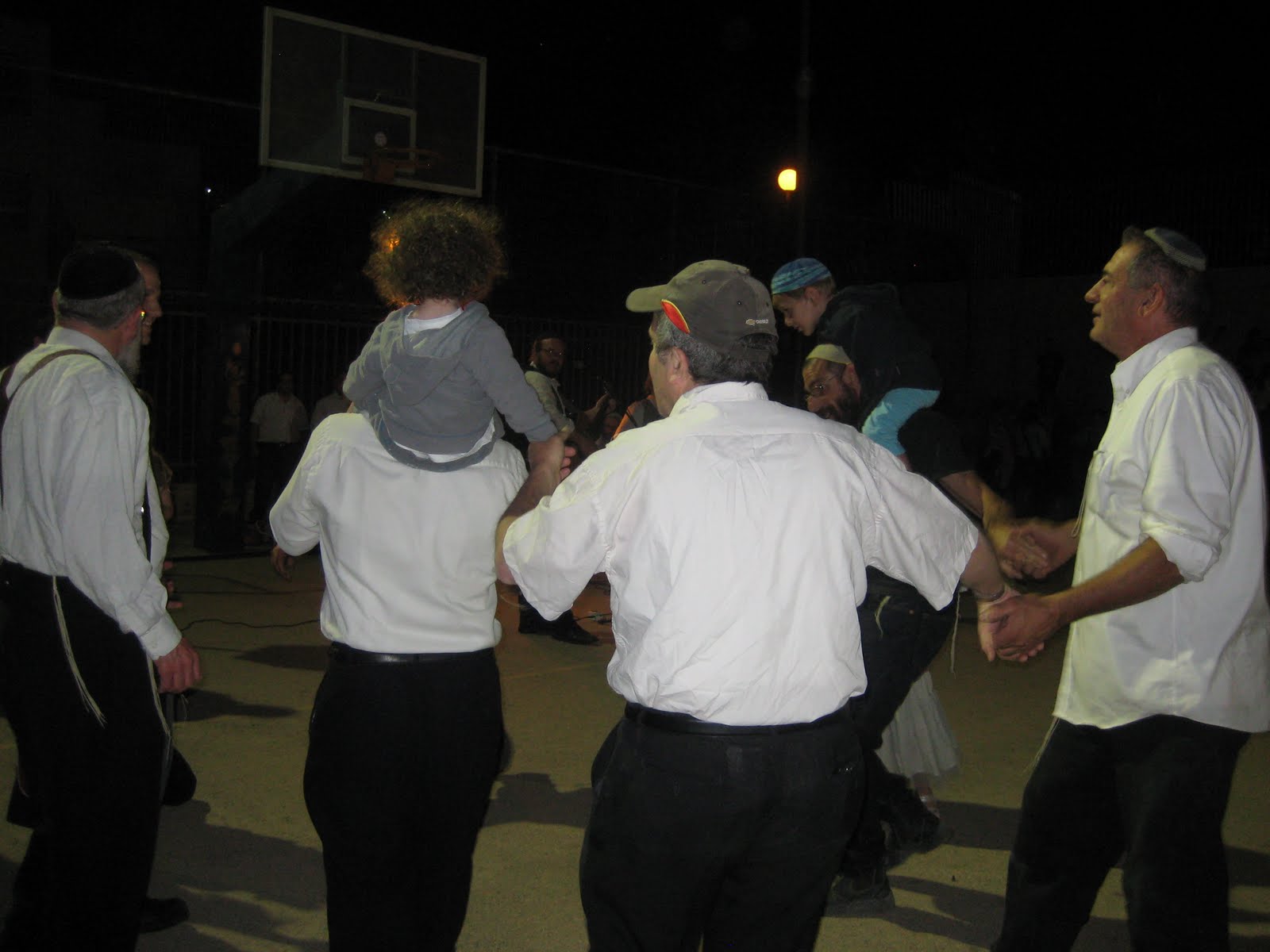
This year, my first Lag b'Omer in Israel, began right after Shabbat ended.  There was an open-air Shlomo Katz/Chaim David concert in the basketball court next to where our shul davens.  I walked around with a huge smile on my face, making small talk, astonished at how many people we already know in our new community, and how many of them have ties to Baltimore.

Some of our neighbors dancing to the music.
After the concert, we drove around Ma'ale Adumim to see how the bonfires were going in other parts of the city.  There were fields and fields with 4, 6, 8 or 10 fires, each a few meters from one another.  We must have seen 60 or 70 individual fires on a quick drive through the city.

If only my camera was as good as my eyes.
In the weeks before Lag b'Omer, we saw kids (mostly boys.... okay, exclusively boys, but I'm sure there were some girls involved too) walking around  with, ahem... borrowed grocery carts filled with sticks and broken wooden furniture and anything else that might burn.

A modest haul.
There were all kinds of fires, from ones that could really be called bonfires...


To ones that are more accurately described as campfires, like this one, obviously built by a boy scout:

Notice the stones surrounding the fire to help contain it.
This surprised me.  People dragged couches, plastic chairs, tables and mattresses to sit by the fire. I'm gonna guess it was mostly the adults who furnished the bonfires.

Sorry it's so dark, but can you find the broken down couch and the plastic chairs in the bottom of the photo?
...and even the ubiquitous mangal, which I think is being used here to barbecue potato slices.  Yum.


I did end the evening with a scratchy throat from the smoke, but there was joy in my heart from so many groups of Jews, gathered together to celebrate with fire, to match the fire in their souls.


And in the morning, cleanup begins.

Wednesday, May 18, 2011

Living Without God in 1971

I like to write about all the big events in our lives in Israel, especially how we spend our first chagim and other special days here.  But there is something more, something constantly in process deep within me.  A few days ago, it arose once again.

I was at a writers' conference.  A writers' conference for women.  A writers' conference for English-speaking, religious women in Jerusalem.

The conference was a satisfying mix of networking with publishers and published writers, industry information and writing inspiration with a spiritual component.  And, in one of the writing exercises, a memory surfaced.

I was a preteen.  We were living in New York, in a suburban neighborhood where every family owned a more-or-less identical private home.  My parents were visiting with neighbors down the street.  I was home alone, or perhaps I was the only sibling still awake.  While watching TV, a commercial for a denture cleaner caught my attention.  I thought about how old people use denture cleaner.  Which lead me to thoughts about aging.  Which led me to thoughts about death.  Before long, I was in a state of sheer terror, because, after death, I couldn't see anything else.

At that age (and for more than a decade after), I lived in a godless universe.  I had no way to express what was, I realize now, an early spiritual crisis.   On the yellow wall phone, the one with the long spiral cord, hanging in the hallway outside the den, barely coherent and choked with tears, I dialed our neighbors and begged my parents to come home.

Life ends.  That realization terrified me, because, in 1971, I was living utterly without God.

Forty years later, I am blessed with a spiritual life beyond my greatest aspirations, one that grows deeper each year.  Once I located my own soul (not so easy when one lives in a godless universe), the journey began.  And that journey ultimately led me to Israel.

I am often struck, when friends and new acquaintances tell their stories of how they came to live in Israel, about how we are all guided here.  It's as if God handpicks us, one at a time, and sets us on a path toward this place.  It has long seemed to me that a significant percentage of olim are either converts or, like me, baalei teshuva.  It's as if, having lived lives without God at all, or without the God of Abraham, Isaac and Jacob, making aliyah is simply a  natural extension of our spiritual journeys.

It isn't always easy to live here.  In fact, it's often difficult to live here, at least at this stage of Jewish history.  We have many enemies, some from without and, sadly, many from within.  But there is an undeniable richness to life here, access to spiritual growth, access to one's own soul, and to God, that can exist nowhere else in the universe.  God lives in Israel.  And, thankfully, so do I.

Tuesday, May 10, 2011

You turned my mourning into dancing (Psalms 30:12)

In the emotional roller coaster that is Yom HaZikaron, Israel's Memorial Day to our fallen soldiers and victims of terror, followed immediately by Yom HaAtzmaut, Israel's Independence Day, there are many tears.  

Last night, we attended the filming of Tuesday Night Live's Yom HaZikaron shows.  Grown men wiped away tears as we watched videos which told the stories of Mikey Levine, a passionate, driven lone soldier who was killed in the Second Lebanon War in 2006 and Avraham Dovid, one of eight boys and young men who were murdered in the Mercaz HaRav massacre in 2008 as they sat and studied Torah.

It is a great and weighty privilege to live in this county in which our Memorial Day means so much more than sale prices on mattresses and radial tires.


I grew up with the 4th of July of course, but learning about Yom HaAtzmaut was simply not part of the curriculum when I was becoming religious.  I first heard the words Yom HaAtzmaut 20 years ago, from a friend who told me about a Yom HaAtzmaut program at her childrens' school.  Ironically, that same school, the one where we sent our children when we still lived in Baltimore, just announced that it's closing its doors at the end of this school year.

So Yeshivat Rambam is closing its doors next month, and I, who first heard about Yom HaAtzmaut in the context of a Yeshivat Rambam celebration, am living in Israel and celebrating the real deal here.

The irony is not lost on me.

Each time our Shabbat table includes seminary students, here for the year studying Torah, we end up talking about their future plans.  When they sit at my table in Israel and say, "I'm going home in X number of months," it makes me cringe, because they still see their homes in someone else's country, even after having the gift of studying and living in Israel for the past academic year.

Some people promote aliyah by talking about the privilege of living in Israel, of being part of the greatest experiment in Jewish history in 2000 years.  There's no doubt that's true.

But there's also the shrinking of the American Jewish community.  In some cases, it's not just shrinking, it's imploding.  Aliyah isn't just for idealists any more.  It's for realists whose eyes are open and who see what's coming around the bend.

I am truly, unspeakably grateful to be a citizen of Israel.

Tonight, in the early hours of Yom HaAtzmaut, I sat in a huge park in our community, eagerly anticipating the celebratory fireworks.


There were 15,000 people at the festival, live music, vendors selling all kinds of glow-in-the-dark chachkes and candies.


Sitting there, it was hard for me to wrap my brain around the fact that this precious, special, now 63 year-old country is threatened.  It all felt so festive, so joyful, so normal.  If anything in Israel can be said to be normal.

All around the country are signs of national pride.  

So many buildings decorated with flags.
Flags fly in roundabouts in Jerusalem.
Flags fly outside the grocery store.
Even the meat counter inside the grocery store displays its patriotism.

And at night, there are the lights that celebrate 63 years of a Jewish country.


It's irrational, how much I love this country.

Happy 63rd Birthday to Israel and all the holy Jews who share this country with my family.

Ten months later, I still can't believe I get to live here.

Wednesday, April 27, 2011

Seeing With Affectionate Eyes

Over Pesach, I read a couple of novels for pleasure.  One of them was Islands by Anne Rivers Siddons, The novel is about a group of lifelong friends and how they cope with aging and loss.  But more to the point, the book is set in Charleston, SC.

I'm pretty sure I've been in Charleston, SC at least once in my life, but it left nary an impression on me. For Anne Rivers Siddons, however, Charleston and the South Carolina Lowcountry is as vivid as a character in the novel.

Generally, I skim quickly over descriptions of scenery in books, jumping to dialog or drama for much the same reason that I prefer lyrics to music alone.  I am exceedingly verbally wired.  I didn't read many of the scenic passages in this book either, but it did occur to me that the author must love that part of the world quite a lot to write about it in such detail.  She sees the South Carolina Lowcountry with affectionate eyes and, as a result, she notices its details - its smells, its sounds, its color.

And that inspired me to notice more of the details in the place I love.  Even though I don't yet feel wholly at home here in Israel, there are so many things I love and, inspired by the novel, I tried to remember to notice them.
In grocery stores all over Israel, the aisles of chametz, foods that we don't eat on Pesach, are covered up.  I know this isn't the prettiest photo, but look below for a detailed image of the graphic.
It says, "Chag Aviv Sameach" in Hebrew.  Even the plastic sheeting in the grocery stores in Israel wishes the Jewish People a happy Passover - a happy springtime holiday.

Today, we drove to the Dead Sea on Route 90. We had the Dead Sea to our left and this amazing vista to our right.  If you look closely at about 9:00, you'll see what I think is an opening to one of the many caves in the the area, not far from Kumran where the Dead Sea Scrolls were found.  This scenery is 30 minutes from our home and  I can go see it whenever I want.
This was a tiny little hop-plop snack bar on the side of the road in the middle of nowhere, selling cold drinks and not much else.  I loved it so much, I wanted to buy something there, just so it would remain in business.
As we sat at the shaded tables eating lunch, I glanced over and saw this tree.  I have no idea  what kind it is, but I love it nonetheless because it grows in Israel.
I saw many other things through affectionate eyes today - like floating on my back in the Dead Sea and looking up at this view:

And the Dead Sea mud hole that was, literally, an unadorned hole in the ground. I didn't get in because I wasn't sure I would have been able to get out, but I did see lots of these mud people.  My mud people.


I've loved these last few days of seeing Israel with affectionate eyes.

May I always be privileged to remember to look.

Thursday, April 21, 2011

Ascending Har HaBayit

A few weeks ago, an old friend sent us an email inviting us to tour Har HaBayit (The Temple Mount) with her family on the first day of Chol HaMoed (the middle days of the Pesach holiday).  Immediately, I felt conflicted.  I knew that ascending Har HaBayit is considered controversial, especially for women.  Har HaBayit is the mountaintop where the First and Second Temples stood and where the Third Holy Temple will be rebuilt very soon, Gd-willing.  The holiness of the site is so extreme, so much more so than the Kotel (Western Wall), that many say we are not spiritually prepared to ascend in these days.

Holiness, or the prospect of being close to such holiness, invokes a feeling of awe.  I wanted to go and was afraid to go in equal measure.  So I asked my rabbi for a ruling according to Jewish law.

He was very encouraging and told us exactly how to prepare.  Ascending the Temple Mount requires immersion in a mikvah and one must wear non-leather shoes.  My friend had arranged for a knowledgeable tour guide to lead us, both to explain what we were seeing and also to keep us on the permitted path, since Jews in today's time may not walk too close to the exact place where the Temples stood.

In the end, we decided to go.  We met near the entrance to the Mughrabi Gate, right off the Kotel Plaza. We were a group of about 15 religious Jews.

At the Mughrabi Gate, throngs of non-Jewish tourists were ushered through as quickly as if they were entering a shopping mall.  A brief pass through a metal detector and off they went.  We, obviously religious Jews, were required to present ID and to wait over half an hour for clearance.  Once we were cleared to enter, we were followed the entire time by a handful of Israeli police officers who kept urging us to move along.

I realize that they are charged with keeping peace, and that, as religious Jews, we might "make trouble", but the fact that non-Jews are assumed to be mere tourists, permitted to walk all over the Temple Mount without escorts while religious Jews are suspected of coming for incendiary purposes is, minimally, hurtful.

Being singled out for an intensive security check, being made to wait while hordes of non-Jews were passed through in moments and being watched and urged along by 3 or 4 eagle-eyed Israeli police were the first of several surprises of the morning.

What were my impressions, as a first-timer?   The mountain top is huge, with many open plaza areas.


There are dozens of Muslim buildings, large and small, up there.


The whole place was filled with Arabs, for whom the Temple Mount, among other things, seems to serve as something of a National Park, with lots of lovely places to have a picnic.

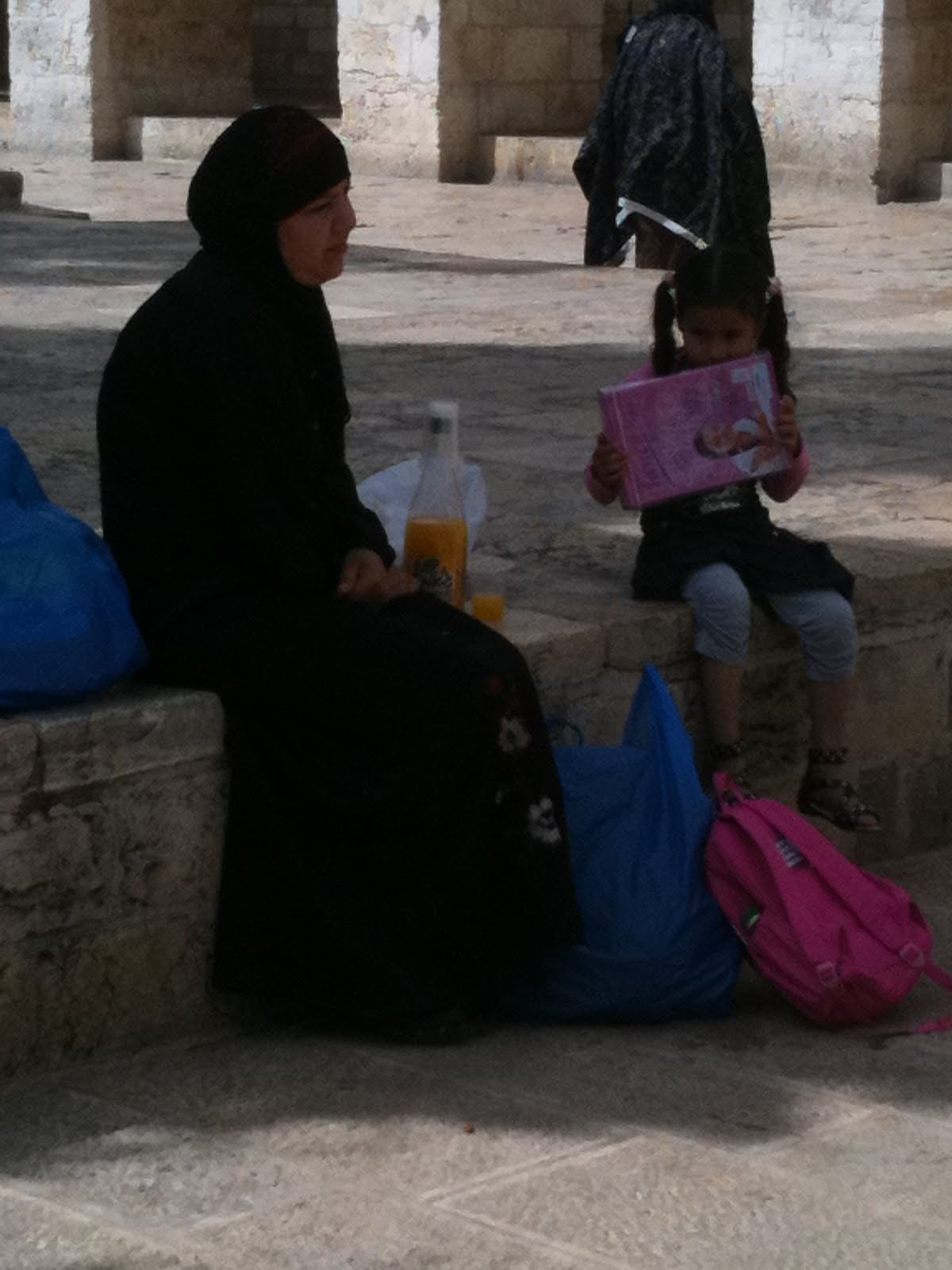
Notice the Arab women enjoying their picnic behind the trees.


Didn't get a photo, but about halfway into our tour, we passed what seemed to be a school with dozens of Arab boys outside at recess, playing soccer, making a lot of noise.  We were walking, quietly and respectfully around the perimeter, being followed like hawks, lest we move our lips in prayer at the holiest Jewish site in the universe, while Arabs were everywhere, eating lunch and playing soccer and non-Jewish tourists were roaming around without a hint of reverence.

One of many non-Jewish groups with whom we shared HarHaBayit.
Deeply, deeply ironic.

That contrast sparked strong feelings among the people in our group.  Why don't more religious Jews come up here?  Why have we ceded the holiest ground in the universe to Arabs, Christians and secular tourists?

While walking around, careful not to move my lips, I spoke to Gd in my head and heart.  I'm sure the others in our group did as well.

Finally, we were near the most dramatic place of all, The Dome of the Rock, built by Muslims in the 7th Century, on the very place where the Temple stood.  It makes me shake with awe to think of how close we were.


We couldn't get any closer.  There is so much more holiness here than anywhere else in the world.  Perhaps that's why this veiled Arab woman chose this exact spot to sit and beg for charity.


At this spot, the tour guide reminded us that, as Jews who ascended Har HaBayit, we were praying with our feet.  He encouraged us to come back and to bring others with us.

As we exited, though an ordinary door into the Arab shuk, the men in our tour group spontaneously burst into song and dance, a prayer for the rebuilding of the Holy Temple.


And that's when I started to cry.